Wired had a great
article recently about the risky rescue of a malfunctioning Air Force communications satellite.
The series of anomalies that occurred are a great example of some of the things that satellite operations teams should be prepared to confront, and made for a very exciting 2 years for the AEHF-1 operations team! First, a bit of background on the satellite, from
Air-Force Magazine:
"The AEHF program, one of the largest space programs of the decade, is designed to augment and eventually replace the legacy Milstar satellite communications network. Lockheed Martin is the prime contractor, Northrop Grumman built the payload, and everything is run by Space and Missile Systems Center at Los Angeles AFB, Calif. The constellation of four cross-linked AEHF satellites is expected to provide a communications capacity exceeding that of Milstar by a factor of 10."
The 7 ton, $2 billion satellite,
AEHF-1, was launched aboard an Atlas V rocket back in August 2010, and at first it seemed to be functioning perfectly. It was placed into an elliptical orbit about 220 km above the Earth's surface, and the first step in the mission was to fire the satellite's hydrazine engine to booste it into a circular, geosynchronous orbit where it would become part of the Air Force's comms satellite constellation.
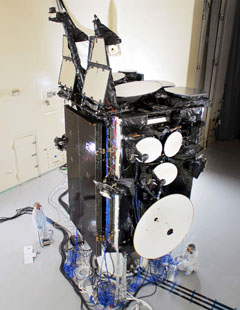 |
AEHF-1 in the clean room.
Credit: Lockheed Martin |
The first sign that something was not right came when the operators first tried to ignite the engine to boost the satellite into geo. Nothing happened. They tried again; the engine did not fire. (In my opinion, firing the engine again was a huge mistake on the part of the operators. As Albert Einstein said, "Insanity is doing the same thing over and over again and expecting different results". In operations, repeating something that didn't work the first time, without first figuring out why it did not work, can mean the end of the mission.) At this point David Madden, the head of the comms satellites at the Space and Missile Systems Center at Los Angeles Air Force Base, stepped in and rounded up a group of engineers who analyzed the telemetry and detrmined that the anomaly was likely caused by a piece of fabric left in the fuel line during the manufacturing process. They also realized that repeated attempts to fire the engine would flood the fuel line and cause the satellite to explode. (Needless to say, they quickly abandoned the "try, try again" tactic.)
With the oxidizer tanks sealed off, rendering the main engine useless, AEHF-1 was stranded in an ineffective and slowly decaying orbit, losing 3 miles of altitude each day. Compounding the problem was the fact that at its altitude AEHF-1 was sharing an orbit with huge amounts of space junk. Operators were having to fire the small thrusters in small maneuvers to avoid debris, wasting valuable fuel.
The operations team was barricaded in a conference room for a week - pizzas were literally slipped to them under the door - and they emerged with a plan to salvage the mission: They would fire the satellite's small thrusters, hydrazine-fueled reaction engine assemblies (REAs) and tiny xenon-fueled Hall Current Thrusters (HCTs). These were originally intended for small orbit adjustments and momentum dumps, but would now be used in a series of more than 450 maneuvers over 14 months to get the satellite into GEO. This would require painstaking planning and precision.
The boosting maneuvers commenced with phase 1 of the recovery procedure: a big orbit-boosting burn to get the satellite out of the danger zone. Very quickly, the second anomaly popped up: The small thrusters required burns that were several hours long in order to be effective, and during these burns the satellite was left with the same side facing the sun, causing components on the sun-facing side to overheat. Overheating can at best diminish mechanism performance, and at worst quickly destroy crucial satellite components. The operations team quickly devised a set of maneuvers to flip the satellite periodically. These maneuvers were inserted during the boosting maneuvers so that no part of the satellite was facing the sun for too long. Flipping the spacecraft, while continuing to keep the thrusters pointed in the right direction and the spacecraft on-target, required an entirely new operations strategy.
Once the schedule of mission-saving maneuvers was in place, operators soon realized that the fuel supply on board was not sufficient to complete the rescue. Every ounce of fuel means another ounce of mass to launch into space (and find space to store onboard the satellite), so the fuel supply is budgeted very carefully based on the minimum mission requirements. Even if AEHF-1 had enough fuel to get to geo, it would still need propellant for station-keeping and momentum management maneuvers once in place, and thus each firing of the minor thrusters meant a shortened mission life. To solve this problem, the software engineers buckled down and re-wrote a chunk of the flight software. The new software allowed operators to position the satellite using the reaction wheels rather than the thrusters, saving fuel. It also optimized fuel consumption in the REA thrusters. The new software was uplinked and implemented successfully.
Engineers calculated the amount of fuel necessary to execute the mission once the satellite was in GEO, and allotted the rest of the fuel to the REA thrusters for the duration of phase 2. When this fuel ran out, the REA thrusters could no longer be used for the rescue effort. At this point AEHF-1 was in the Van Allen radiation belt, a high radiation zone where energetic charged particles are held in place by the Earth’s magnetic field. These particles can damage a satellite's electrical system very quickly, especially the solar panels. This presented a catch-22 for the ops team, because escaping the Van Allen Belt without the REA thrusters would require using the HCT thrusters, which run on electric current. Generating electric current, of course, would require deploying the solar arrays and exposing them to the dangerous radiation of the Van Allen Belt. After much deliberation, the team came up with a strategy to deploy the arrays and fire the thrusters quickly to escape the danger zone with minimal damage.
Once out of the Van Allen Belt, Stage 3 of the rescue continued, with the ops team relying solely on the HCTs to perform the necessary boosting maneuvers. HCTs are generally used for station-keeping maneuvers, and they use electricity and Xenon fuel to emit short, relatively weak puffs of power. However, they can burn for thousands of hours. They had never been used for extended amounts of time in zero G.
 |
| Source: Air-Force Magazine |
The HCT motors were optimized to fire at the apogee (the point in the orbit farthest from the Earth) of the AEHF satellite’s orbit, in order to increase the orbit's perigee (the point in the orbit closest to the Earth). (Think of it like a lever - the farther out you push, the more thrust you get). From late October 2010 to June 2011, the HCTs burned for 10 to 12 hours per day. This required frequent analysis and tuning. Madden described the tedious process: "They’re like a finicky old car, one that you’ve got to constantly adjust to get it to optimize. There’s no instruction manual for how to do that. It’s basically an art."
Once the satellite reached its target altitude of 17,000 miles, the orbit had to be circularized at the correct inclination, which required additional burns to increase the perigree to 22,000 miles, decrease the apogee by 10,000 miles, and drive the inclination down closer to the equator to allow the satellite to see more of the Earth. The ops team timed the burns to take advantage of the beneficial effects of Earth’s gravitational pull, thereby conserving valuable fuel.
Finally, after almost two years, the satellite reached it's target location, and the payload was successfully deployed. Madden says that it still has enough remaining fuel to continue operating for it's full planned lifetime of 14 years. (Of course, this is likely due to the habit of aerospace companies to grossly and purposefully under-predict lifetimes to ensure mission success; with a full tank of gas I'm sure the team was hoping the satellite would last much, much longer.) Nevertheless, it was a remarkable and complex recovery effort. I am sure it was a giant relief to finally deploy the payload, which had been stored inside the satellite in order to fit in the Atlas V launch cone, and see that it worked. Next up: the team will launch and deploy AEHF-2. Best of luck to them, although I bet the operations team is pretty sick of the entire AEHF family at this point.
Summary of Anomalies:
Anomaly 1: Clogged fuel line
Solution: Use REA thrusters to boost orbit
Anomaly 2: Potential Collisions with Space Debris
Solution: Small maneuvers with REA thrusters, and rapid exit from LEO
Anomaly 3: Overheating during orbit-boosting maneuvers
Solution: Periodic spacecraft flips during maneuvers
Anomaly 4: Fuel Shortage
Solution: Re-write/load of the flight software to optimize fuel consumption for new operations plan; Strategic scheduling of burns to take advantage of orbital and gravitational affects.
Anomaly 5: High radiation from Van Allen Belt
Solution: Rapid Solar Array deployment and use of Hall Current Thrusters to quickly boost altitude.


