Showing posts with label Constellation. Show all posts

Monday, January 21, 2013

Planetary Resources Reveals Telescope Prototype

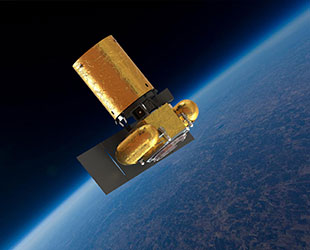
An artist's rendition of the Arkyd-100 in orbit.
Planetary Resources, the startup aiming to make billions of dollars mining platinum from asteroids in our solar system, recently revealed their prototype for the Arkyd-100 Space Telescope. A fleet of these telescopes will eventually be launched to search for minable, accessible, asteroids. It is an amazingly small and compact 11 kg satellite with small deployable solar arrays - significantly smaller than the prototype they previously debuted. The telescope is compact for launch, but can be extended several inches once deployed in space, increasing its focal length.

Among the most interesting revelations is the company's plan to use the telescope for laser communications rather than relying on a network of radio dishes. Laser communications is a really neat technique. Basically, instead of sending telemetry and images over modulated longer-wavelength radio waves (like most satellites do to communicate with ground stations on Earth), you use shorter-wavelength waves in the visible spectrum. This has many benefits:
  • Because shorter wavelengths have higher energy, you can transmit information at a much higher density, or data rate.
  • Radio and television stations transmit in the radio wavelengths, so anyone operating a radio transmitter needs a license to avoid interference. The optical spectrum has none of these restrictions.
  • Laser receptors/transmitters on the ground are much smaller and cheaper to build and operate than their radio counterparts.
  • For satellites with imaging payloads, the telescope can be used both as an optic to collect light (take images or receive information) and as a laser to send it (transmit images to the ground). there is no need for a separate radio antenna that takes up room and adds mass to a satellite.
The main drawback of laser communications is that water vapor in Earth's atmosphere absorbs waves in the visible spectrum (that's why it's dark on a cloudy day). Moreover, it requires extremely precise pointing in order to hit receptors on Earth. This is why long-range laser communications are currently only widely used in space-based satellite to satellite communications where water vapor is not an issue. However, if these obstacles can be overcome (by using continual weather analysis to find clear areas with no clouds and arid climates to transmit, and building robust stabilization systems to point the spacecraft), then laser communication can be an incredibly efficient and cheap option. Planetary Resources says it is under contract with NASA to develop this technology for use on future government-funded satellites.

The company says it hopes to sell its satellites to other companies to help fund its ultimate goal of retrieving and selling valuable platinum from an asteroid. I will certainly be watching as their design matures and progresses!

You can watch their informational video, which includes a small tour of their facilities, here.

Saturday, May 26, 2012

Can Constellation Rise from the Ashes?

Back in 2010 the Obama administration canceled Constellation, Bush's space program that would have sent US astronauts back to the moon, and eventually to Mars and beyond. I do not agree with President Bush on very much, but his ambition and vision for NASA was laudable, and I was sad when they cancelled Constellation. Despite being “over budget, behind schedule, and lacking in innovation due to a failure to invest in critical new technologies” according to the White House's budget plan, Constellation did provide an exciting and inspiring goal: Mars. The same cannot be said of Obama's replacement plan to focus on "building block technologies" and eventually send US astronauts to an asteroid. The goal is not nearly as romantic, and half the US population thinks it has already been accomplished. Moreover, with the recent explosion of Planetary Resources onto the public stage, we now see that there are market forces sufficient to propel private sector missions to asteroids; the same cannot be said of missions to Mars. In this new age of privatized space, NASA's main goal should be to fund innovative research and missions that would not otherwise be funded due to a lack of immediate profitability. But I digress. 


The Liberty launch vehicle combines the proven systems from NASA's space shuttle fleet and 
Europe's Ariane 5 expendable rocket. This graphic shows how they combine into the new 
ATK-Astrium Liberty rocket. CREDIT: ATK
It now seems that Constellation might just make like a Phoenix and rise from the congressional ashes. Development of the Orion Crew Module, which would have carried astronauts to Mars, has continued under the new title of "Multi-Purpose Crew Vehicle" (MPCV) since program cancellation. And now it looks like the heavy-lift vehicle, (née Ares 1), which would have propelled Orion into space, is not completely dead either. On May 9th, Alliant Techystems (better known as ATK) announced plans to combine the first stage of the Ares 1, a five-stage solid rocket booster, with the second stage of the European Space Agency's Ariane V rocket, which has been in use since '96, to make the "Liberty Rocket". These rocket stages would be topped with ATK's own Orion spinoff, with a composite structure and less robust heat shield than the metal Orion system since ATK's version would only be reentering the atmosphere from LEO instead of deep space and thus have half the energy to dissipate upon reentry. ATK plans to develop the Liberty Rocket system into a full-fledged commercial enterprise, carrying crew and cargo into low earth orbit for both NASA and other commercial space venture companies. ATK thinks it can move quickly through development and testing since the first two rocket stages have already been tested thoroughly. They hope to launch their first test flight by 2015.


I'm glad to see that the billions of dollars and thousands of hours of hard work already poured into Orion and Ares may not have been for naught, but I have reservations about the frankenstein nature of Liberty. Rand Simberg, in a great summary of the program, pointed out that using the Ariane V as a second stage (rather than as a first stage, as it has been used by the ESA) will mean coordinating in-flight ignition of the very complex combustion engine. The difficulty of pulling this off is one of the reasons that the Space Shuttle's SSME was abandoned by NASA's Constellation team for the J2-X. 


I also can't imagine that integrating 3 different rocket stages, built by three different companies, will yield an elegant, cost-effective, or scalable result. The Ariane 5 brings 15 years of ESA heritage technology with it, the Ares rocket undoubtedly possesses the marks of 60+ years of NASA history, and the Orion capsule is being developed by Lockheed Martin, which has its own hefty share of heritage. The plan greatly undervalues the benefits of in-house design. SpaceX, for example, built their entire system (rocket and capsule) from scratch in-house. The mechanical engineers building the Falcon engines eat lunch with the electrical engineers designing the Dragon capsule and the systems engineers building the operational plans (I saw this with my own eyes when I visited SpaceX headquarters in 2010). While an ATK systems engineer will have three sets of clumsy and likely incomplete documentation to sift through, and none of the original designers to help with the task, a SpaceX engineer who wants to know why something was built a certain way merely has to find the person who designed it and ask. ATK's kludged-together rocket might be cheap and fast now, but I doubt that it will be scalable or easily updated in the long-term. 


In any case, it is likely that Liberty - which will require support from the Ares team - will receive support from members of Congress who championed Constellation and would like to see those jobs return to their districts. It will be interesting to see how Liberty changes course once it enters the political sphere.