Showing posts with label Solar arrays. Show all posts

Monday, January 21, 2013

Planetary Resources Reveals Telescope Prototype

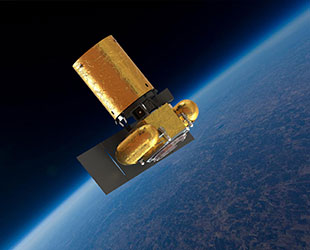
An artist's rendition of the Arkyd-100 in orbit.
Planetary Resources, the startup aiming to make billions of dollars mining platinum from asteroids in our solar system, recently revealed their prototype for the Arkyd-100 Space Telescope. A fleet of these telescopes will eventually be launched to search for minable, accessible, asteroids. It is an amazingly small and compact 11 kg satellite with small deployable solar arrays - significantly smaller than the prototype they previously debuted. The telescope is compact for launch, but can be extended several inches once deployed in space, increasing its focal length.

Among the most interesting revelations is the company's plan to use the telescope for laser communications rather than relying on a network of radio dishes. Laser communications is a really neat technique. Basically, instead of sending telemetry and images over modulated longer-wavelength radio waves (like most satellites do to communicate with ground stations on Earth), you use shorter-wavelength waves in the visible spectrum. This has many benefits:
  • Because shorter wavelengths have higher energy, you can transmit information at a much higher density, or data rate.
  • Radio and television stations transmit in the radio wavelengths, so anyone operating a radio transmitter needs a license to avoid interference. The optical spectrum has none of these restrictions.
  • Laser receptors/transmitters on the ground are much smaller and cheaper to build and operate than their radio counterparts.
  • For satellites with imaging payloads, the telescope can be used both as an optic to collect light (take images or receive information) and as a laser to send it (transmit images to the ground). there is no need for a separate radio antenna that takes up room and adds mass to a satellite.
The main drawback of laser communications is that water vapor in Earth's atmosphere absorbs waves in the visible spectrum (that's why it's dark on a cloudy day). Moreover, it requires extremely precise pointing in order to hit receptors on Earth. This is why long-range laser communications are currently only widely used in space-based satellite to satellite communications where water vapor is not an issue. However, if these obstacles can be overcome (by using continual weather analysis to find clear areas with no clouds and arid climates to transmit, and building robust stabilization systems to point the spacecraft), then laser communication can be an incredibly efficient and cheap option. Planetary Resources says it is under contract with NASA to develop this technology for use on future government-funded satellites.

The company says it hopes to sell its satellites to other companies to help fund its ultimate goal of retrieving and selling valuable platinum from an asteroid. I will certainly be watching as their design matures and progresses!

You can watch their informational video, which includes a small tour of their facilities, here.

Wednesday, June 20, 2012

Intelsat IS-19 Deploys Damaged Solar Array

Intelsat's IS-19 communication satellite, which will provide telecommunications services and broadband coverage in the Pacific Ocean region, finally deployed its south solar array yesterday, after keeping it stowed for 13 days. The solar array sustained severe damage during launch, and was stuck in the stowed position for several days. Once deployed, operators estimated that the damage reduced the array's power-collecting capacity by half. The spacecraft is still operational, but will only be able to reach 75% power capacity.
IntelSat-19.
Credit: Space Systems/Loral

IS-19 was built by Space Systems/Loral, in Palo Alto, CA, and launched by the Swiss company Sea Launch. Both sides continue to deflect blame for the damage, but Sea Launch did report an "unexplained pressure event" 72 seconds into the launch, which mirrors a similar event detected in the Sea Launch rocket in 2004, when launching another Space Systems/Loral satellite (Telstar 14/Estrela do Sul 1) whose solar array never deployed.

Sea Launch has released launch telemetry indicating that "all systems performed nominally throughout the launch profile...Boeing engineers did notice an unexpected, isolated event around 72 seconds after launch" . They cheekily point the finger by adding "while it is premature to speculate on its origin…it bears a striking resemblance to a prior Space Systems/Loral mission". 

It is worth noting that Space Systems/Loral has a small history of challenged solar arrays. The company also built Telstar 14R (Estrela so Sul 2), which experienced a problem deploying the solar arrays after launch as well, but was launched on a Russian Proton rocket.

The Sea Launch platform - a converted
oil rig. Credit: Sea Launch
Sea Launch is an interesting company - it launches its Zenith 3SL rockets from a converted oil rig which is towed from Long Beach, California to the middle of the Pacific Ocean right on the equator, an optimal location for launching satellites to geosynchronous transfer orbits. The company was formed in 1999 as a joint venture between companies from Norway, Russia, the Ukraine, and the United States, and is managed by Boeing. It recently emerged from bankruptcy in 2010 and has had two successful launches in as many years.

Wednesday, May 23, 2012

SpaceX Launches Dragon Capsule

After a two day delay due to an anomaly in one of the rocket engines, SpaceX's falcon 9 rocket blasted off early this morning, launching a Dragon capsule filled with cargo for the ISS.
There was plenty of news coverage of the event, but there were three little tidbits that I especially enjoyed.
  1. The description of the humorous juxtaposition of the young, casual, SpaceX mission controllers with the suited NASA old guard in the control room: "Many of the SpaceX controllers wore untucked T-shirts and jeans or even shorts, a stark contrast to NASA’s old suit-and-tie shuttle team."
  2. View from Spacex's Dragon spacecraft looking outward
    at one of two solar array panels in the process of deploying.
    Source: SpaceX
  3. The picture that @SpaceX tweeted of the Dragon capsule solar arrays after they deployed. News reports say the cheering in the control room after the successful deployment of the solar arrays was almost louder than the cheering following the successful launch. In many ways, deploying the solar arrays is the most stressful, high stakes activity of commissioning. It takes less force, and different mechanics, to deploy arrays in a zero G environment than it does on Earth. In fact, many spacecraft (like the James Webb Telescope) are never able to fully test solar array deployment on Earth; gravity makes the solar arrays too heavy to operate with the motors that will be used in space. Operators must trust in the capability of the mechanical engineers and software simulations without ever testing the full deployment procedure. I have a friend who was working on a satellite at Space Systems Loral when one of the solar arrays failed to deploy during commissioning. In a last ditch effort to save the spacecraft they fired a spacecraft thruster at the array to try to push it out, and ended up losing whatever capability they had from the partially deployed array by blowing a hole through it. The satellite is now a very expensive piece of space junk, floating around in GEO with 100 million dollars worth of expensive, cutting edge technology and equipment, and no power. 
  4. The smaller, public interest news articles about Celestis, the for-profit company that sent the ashes of 300 people to orbit aboard the Falcon 9. The "special payload" included the remains of James Doohan (Scotty, from Star Trek) and Gordon Cooper (one of the famous Mercury 7 astronauts). The ashes were in the second stage of the Falcon 9 rocket, which was jettisoned about 10 minutes after launch and will remain in orbit for about a year before its orbit decays and it burns up in Earth's atmosphere. This was actually the backup flight for Celestis - the first round of ashes failed to make it to orbit on the botched 2008 SpaceX launch that crashed into the Pacific Ocean.
Congrats to SpaceX! I am excited to follow the mission over the next two weeks as the Dragon performs several maneuvers and is eventually grabbed by ISS astronauts using the station's robotic arm. The SpaceX Ops team has a lot on their plate - It must be an incredibly exciting experience, but I don't envy the pressure on them or their likely sleep schedule for the next two weeks!