Showing posts with label Ball Aerospace. Show all posts

Friday, January 18, 2013

Kepler Reacts to a Sticky Wheel

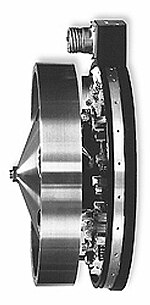
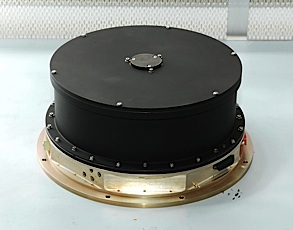
In a Kepler Mission Manager Update, NASA announced today that the Kepler mission is temporarily ceasing science operations due to increased friction in reaction wheel #4. Kepler is a NASA satellite that has been searching for Earth-like planets around nearby starts since it launched in 2009. Reaction wheels are used to maneuver satellites and other spacecraft requiring fine, continuous pointing control. A motor spins up the reaction wheel in one direction, which causes the spacecraft to spin in the opposite direction. Spacecraft almost always have 4 reaction wheels: one for each axis of rotation, and one spare. If two or more reaction wheels fail, the spacecraft loses it's ability to attain and hold commanded positions. For a telescope like Kepler, where steady pointing is critical to collecting high quality images of faint stars, this is a mission ending-anomaly.

The type of reaction wheel used on Kepler
Source: Ball Aerospace
This isn't the first road bump for Kepler. The spacecraft experienced problems with reaction wheel #2 back in July 2012, and took steps to mitigate future risk at that time. Among other things, they decided to increase operational temperatures  (likely to keep the lubricant in the wheels warmer);  increase spin-rates (because the faster wheels spin, the less likely they are to get stuck, and the more the lubricant gets distributed nicely), and implement bi-directional rotation (to even out any use-related wear and tear).

Reaction wheel side view
The Kepler operations team is dealing with this latest threat to the mission by putting Kepler in a ten day "rest period" to give the wheel's lubricant time to become more evenly distributed. During this time the wheels will not be used, and a modified safe mode attitude (where the solar arrays are pointed at the sun to keep the spacecraft power-positive) will be maintained using thrusters.

Reaction wheel problems seem to be prevalent lately, especially in high profile missions. In August, Operators for the Dawn Mission also experienced complications or failures with two of its reaction wheels. Dawn had already lost a reaction wheel in June 2010 when it lost a second wheel in August. It is now using an inventive combination of the two remaining reaction wheels and its hydrazine thrusters to point the spacecraft (this solution is not sufficient for the strict pointing requirements of Kepler).

It is interesting to note that the operations teams identified the anomaly differently in each case. Kepler operators noticed that the amount of torque needed to change the spin rate of its reaction wheel was higher than normal during a semiweekly contact with the spacecraft, indicating increased friction in the wheel. Dawn operators became aware of the problem when the spacecraft software detected the problem and initiated an automatic shut down of the wheel.
Saturday, June 30, 2012

The B612 Foundation


Antoine de Saint-Exupéry's Little prince on the original B612 asteroid.
On June 28th, the B612 foundation announced its plans to build, launch, and operate a deep-space telescope, Sentinel, which will find and map asteroids that could pose a danger to planet Earth. The official press release summarizes the mission:
“The orbits of the inner solar system where Earth lies are populated with a half million asteroids larger than the one that struck Tunguska (June 30, 1908), and yet we’ve identified and mapped only about one percent of these asteroids to date, said Ed Lu, Space Shuttle, Soyuz, and Space Station Astronaut, now Chairman and CEO of the B612 Foundation. “During its 5.5-year mission survey time, Sentinel will discover and track half a million Near Earth Asteroids, creating a dynamic map that will provide the blueprint for future exploration of our Solar System, while protecting the future of humanity on Earth.”
The B612 foundation has actually been around since 2001, working towards its mission of protecting Earth from a potentially disastrous asteroid impact. Prior to yesterday's announcement they had been focusing on technologies that could deflect threatening asteroids away from Earth's orbit, such as gravity tractors, kinetic impactors, and nuclear vaporization. However, they eventually realized that these technologies would be useless if no one knows the asteroid is coming, and that nobody was doing anything to find and track the most threatening asteroids. the organization's website explains: 
"NASA’s Spaceguard survey has succeeded in mapping 90 percent of the largest NEAs (larger than 1 km), yet due to the limitations of searching for asteroids using mostly ground based optical telescopes, only about one percent of these asteroids larger than Tunguska have been discovered and tracked to date. We are essentially flying around the Solar System with our eyes closed." 
The foundation estimates that in 5.5 years, Sentinel will have identified around half a million Near Earth Asteroids, with enough temporal information to project their orbits 100 years into the future. They think there is a 50% chance that the mission will identify at least one asteroid on a collision course with Earth that will need to be deflected in order to prevent a potentially catastrophic Earth impact.
The Sentinel Telescope (preliminary design by Ball Aerospace).
Source: B612


The Sentinel telescope will operate in the infrared, where asteroids stand out against the cold blackness of space, and be built by Ball Aerospace, the same folks that built the Kepler, Spitzer, and Hubble telescopes. It will be placed into an orbit similar to Venus's. This orbit will allow it to scan the side of the Sun opposite from Earth, which it would not be able to do if it were in orbit around Earth. However, it will also make operations and communications tricky because its distance from Earth will vary between 30 - 170 million miles, as opposed to the much more cozy 350 milles between Earth and Hubble. This is difficult but by no means unheard of - we have been operating spacecraft on Mars and beyond for tens of years. Current estimates put launch in 2017-2018, aboard one of SpaceX's Falcon 9 rockets.


Sentinel's orbit, which will allow it to map the side of the Sun opposite from Earth.
Source: B612 foundation. 
The B612 Foundation has signed a Space Act Agreement with NASA in June 2012, under which NASA will provide communications, tracking, and technical support for the Sentinel Mission. However, B612 is a nonprofit 501(c) 3 organization that "intends to raise the money for the Sentinel Mission in a manner similar to philanthropic capital campaigns for civic projects." If they do it right, and take advantage of flashy publicity videos and social media, I bet they could raise the necessary money very quickly - this is a subject that people can easily get excited about. 


Kudos to the B612 foundation for taking on a huge but necessary project. As John Stuart recently put it, "Do you know how rarely the news in 2012 looks and sounds how you thought news would look and sound in 2012?"