Showing posts with label Kepler. Show all posts

Friday, May 17, 2013

Kepler Loses Another Reaction Wheel.

It was Deja Vu all over again yesterday, as the Kepler team at NASA announced the probable failure of the spacecraft's second reaction wheel. Kepler is a NASA satellite searching for exoplanets (planets outside our solar system) by finding stars with periodic variation in their brightness, which would indicate planets passing in front of them. Kepler needs three working reaction wheels in order to maintain the necessary level of pointing precision for science operations. It lost reaction wheel #2 back in 2012, so it's been operating without a spare ever since. I first wrote about Kepler in January 2013, when Reaction Wheel #4 (the second reaction wheel to exhibit problems) was showing signs of degradation and poor performance. After a ten day rest period, which operators hoped would redistribute lubricant in the reaction wheel and allow it to spin more easily, the Kepler team returned the spacecraft to full operations with the hopes that the wheel could hang in there. Turns out, it couldn't.
The location of Kepler's reaction wheels.
Source: NASA

On Wednesday NASA announced that the wheel seemed to have failed again. During a semi-weekly contact with Kepler, operators found the spacecraft unexpectedly in safe mode, which is what the spacecraft does when it detects something is wrong. In this mode it ceases science operations and faces the sun to gather as much power as possible, allowing the communicating line with Earth to drop in and out as it spins around the Sun. When operators commanded the reaction wheels to stop rotating the vehicle in order to maintain the communication link, reaction wheel 4 stopped spinning, but maintained full torque, meaning that it was trying as hard as it could to spin up but was not moving at all. This behavior likely indicates a structural failure of the wheel bearing. In other words, bad news bears.

NASA says the Kepler mission was originally only 3.5 years, so technically Kepler completed all of its mission goals. However, it is standard for missions like this to low-ball the life expectancy so that they can tell congress it will cost less, and claim 100 percent mission success even if something goes wrong later in the life of the spacecraft. In reality, missions are often extended for 2-5 times the original mission life. When Kepler reached its original 3.5 year mission goal in 2012, funding for the satellite was extended for six more years. There had been more noise than anticipated in Kepler's data, due to worse than expected signal and more noise than anticipated in the spacecraft, so observations were taking longer than originally expected. It was estimated that Kepler would take until 2015 to fulfill all of it's mission goals. So, if Kepler is headed for hospice, it will have reached it's originally planned mission life, but not entirely fulfilled it's mission goals.

But all is not lost! Kepler operators have not given up on attempts to resuscitate the wheel. They plan to try jump starting it by sending start and stop commands in rapid succession, and perhaps spinning it in the opposite direction. If all attempts fail, they may investigate pursuing other science goals using a scanning mode, where 3-axis control is not necessary.

Even if rejuvenation in some form is not possible, the mission is far from a bust. Kepler has made significant contributions to science and the search for planets. It has identified 2740 candidate stars, and led scientists to estimate that there are at least 17 billion Earth-sized exoplanets in the Milky Way Galaxy alone. There is also a huge trove of data from Kepler that has not been analyzed yet, and will provide fodder for research and discovery for years to come. There may very well be data revealing an Earth-sized star in the habitable zone of a far-away planet, just sitting on a server somewhere waiting to be extracted. And Kepler is just the beginning of that search - NASA is already planning the next generation of exoplanet-finding telescopes, starting with TESS, which would launch in 2017.

Friday, January 18, 2013

Kepler Reacts to a Sticky Wheel

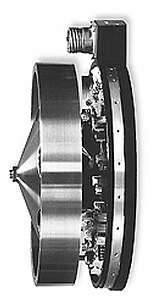
In a Kepler Mission Manager Update, NASA announced today that the Kepler mission is temporarily ceasing science operations due to increased friction in reaction wheel #4. Kepler is a NASA satellite that has been searching for Earth-like planets around nearby starts since it launched in 2009. Reaction wheels are used to maneuver satellites and other spacecraft requiring fine, continuous pointing control. A motor spins up the reaction wheel in one direction, which causes the spacecraft to spin in the opposite direction. Spacecraft almost always have 4 reaction wheels: one for each axis of rotation, and one spare. If two or more reaction wheels fail, the spacecraft loses it's ability to attain and hold commanded positions. For a telescope like Kepler, where steady pointing is critical to collecting high quality images of faint stars, this is a mission ending-anomaly.

The type of reaction wheel used on Kepler
Source: Ball Aerospace
This isn't the first road bump for Kepler. The spacecraft experienced problems with reaction wheel #2 back in July 2012, and took steps to mitigate future risk at that time. Among other things, they decided to increase operational temperatures  (likely to keep the lubricant in the wheels warmer);  increase spin-rates (because the faster wheels spin, the less likely they are to get stuck, and the more the lubricant gets distributed nicely), and implement bi-directional rotation (to even out any use-related wear and tear).

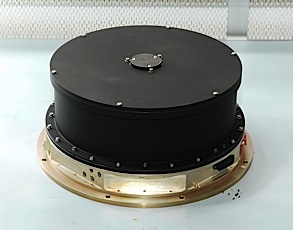
Reaction wheel side view
The Kepler operations team is dealing with this latest threat to the mission by putting Kepler in a ten day "rest period" to give the wheel's lubricant time to become more evenly distributed. During this time the wheels will not be used, and a modified safe mode attitude (where the solar arrays are pointed at the sun to keep the spacecraft power-positive) will be maintained using thrusters.

Reaction wheel problems seem to be prevalent lately, especially in high profile missions. In August, Operators for the Dawn Mission also experienced complications or failures with two of its reaction wheels. Dawn had already lost a reaction wheel in June 2010 when it lost a second wheel in August. It is now using an inventive combination of the two remaining reaction wheels and its hydrazine thrusters to point the spacecraft (this solution is not sufficient for the strict pointing requirements of Kepler).

It is interesting to note that the operations teams identified the anomaly differently in each case. Kepler operators noticed that the amount of torque needed to change the spin rate of its reaction wheel was higher than normal during a semiweekly contact with the spacecraft, indicating increased friction in the wheel. Dawn operators became aware of the problem when the spacecraft software detected the problem and initiated an automatic shut down of the wheel.